
The Cold Start Problem and How to Solve It
Why the smartest founders fake one side of the market before building the other

You’ve Never Seen a Two-Sided Market Work When It Started
Here’s something that doesn’t get talked about enough: the hardest thing in business isn’t building a great product or finding customers. It’s solving the cold start problem for two-sided networks.
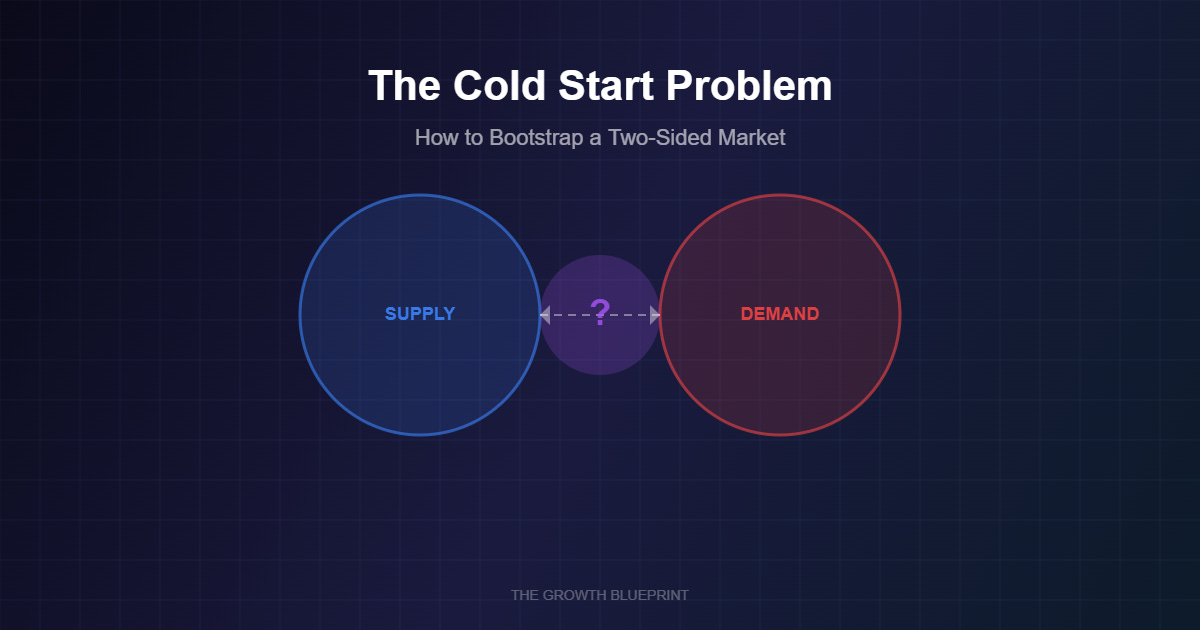
A two-sided market is anything where you need both sides to show up to have value. Marketplace platforms. Social networks. Payment systems. Dating apps. Any product where you need both supply and demand.
The problem is obvious: you need suppliers to attract customers, but you need customers to attract suppliers. You need both sides before either side benefits.
How do you bootstrap that?
Most people think the answer is to subsidize one side. Subsidize the supply side to create inventory, and then demand follows.
That’s one solution. But it’s expensive. Uber and Lyft burned billions subsidizing driver supply before demand took off.
There are better ways.
The Service-First Approach
The best solution I’ve seen to the cold start problem is what I call the service-first approach.
You fake one side of the market by doing it yourself.
The most famous example of this is Brian Chesky and Joe Gebbia starting Airbnb. They couldn’t get hosts to list properties because there were no guests. They couldn’t get guests because there were no properties.
So they went to New York. They manually photographed apartments. They listed them on the platform themselves. They created the supply that attracted demand.
Eventually, real hosts saw that guests were actually coming, and started listing their own properties. Demand grew as supply grew.
That worked.
The same pattern shows up at Instacart. Apoorva Mehta didn’t have grocery stores signing up to offer delivery. He personally went to stores, checked items, and delivered groceries. He created the service that attracted demand.
Once demand existed, grocery stores wanted to participate.
It’s the opposite of the usual playbook, but it works because it solves the cold start problem at the root. You don’t need both sides to exist simultaneously. You create one side, prove it works, and then the other side follows.
Why This Works Better Than Subsidies
The reason this works is that it builds momentum without spending money you don’t have.
When you subsidize, you’re paying to fake demand or fake supply. You’re paying for growth. And your unit economics are terrible. You’re burning cash.
When you service-first, you’re working. You’re delivering real value. You’re learning what people actually want. And you’re building a real product based on real behavior.
Airbnb didn’t guess what guests wanted. They watched guests use the platform. They saw what properties got booked. They learned. Then they improved.
Instacart didn’t guess what groceries people wanted to order. They delivered groceries themselves and learned what items people actually ordered.
And here’s the thing: both companies eventually had to do the work of onboarding real hosts and real shoppers, but they did it from a position of strength. They could say “Look, we’ve done this. People want this. Here’s what works.”
That’s way more powerful than “We think this could work. Please try it.”
The Network Effect Unlocks Later
Once you’ve solved the cold start problem and you have real supply and demand, the network effects kick in.
When Airbnb had real listings in real cities, and real guests actually booking them, hosts wanted to join because there was actual demand. Demand wanted to join because there were actual listings.
The growth became self-sustaining.
But you only get there if you solve the cold start problem first.
I watched a marketplace founder try to launch with both sides simultaneously. They put out a call to merchants. They put out a call to customers. They waited for both sides to show up.
Neither side showed up. Why would merchants list products if no one was buying? Why would customers shop if there were no products?
The founder got frustrated and gave up.
If they’d gone with the service-first approach, they would have manually acquired the first supply, attracted some demand, then attracted real suppliers.
The Framework
Here’s how to apply this to your two-sided network.
First, decide which side is harder to get initially. Is it harder to get merchants or customers? Hosts or guests? Suppliers or demand?
Usually, supply is harder. People are willing to buy if there’s something to buy. People are less willing to sell if there’s no one to sell to.
So supply-first is usually the move.
Second, do the supply yourself. Get your hands dirty. Source the first products. Create the first listings. Deliver the first service. You’re not trying to scale this. You’re trying to prove the concept.
Third, measure what works. What products sell? What prices work? What service experience do people want?
Fourth, once you’ve proved it works, recruit real suppliers. Now you can say “Look, we’ve done this. Customers want it. Here’s what works. Now you do it and keep the margin.”
Real suppliers are way more likely to join when they can see proof that customers exist.
Fifth, grow both sides aggressively from there.
The Timing is Critical
One thing that matters: you do the service-first phase quietly. You’re not launching publicly. You’re not raising money on “we’re going to be a marketplace.”
You’re solving a real customer problem. You’re doing it manually. You’re learning.
Once you’ve got real supply and real demand, real customers using your product, then you start thinking about scaling both sides.
The companies that win at this are the ones who spend three to six months solving the cold start problem before they talk about being a platform.
Your Turn
If you’re building a two-sided network, here’s what I want to know: which side are you trying to get first?
And more importantly, have you considered doing the hard side yourself for a while before trying to recruit partners?
It feels like you’re not scaling. It feels like you’re not moving fast. But you’re actually building moat. You’re creating proof of concept. You’re learning what works before you ask other people to bet on it.
Reply and tell me how you’re thinking about your cold start problem.